
Hey all! I’m sorry for my absence from WordPress. Life got in the way, you know? A sick cat, work, and general life changes all struck me in the past 2 weeks. Hopefully, I’ll be getting my reading back on track in the next few days. I’m excited for this next review, because I believe it’s an important YA book for youth today. Thanks for reading!
10 Things I Can See From Here by Carrie Mac
“Don’t look down. Look around. Tell me ten things that you can see from here.”
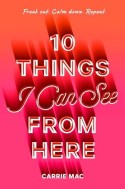 Genre: YA fiction
Format: Paperback ARC
Publication date: Feburuary 28, 2017
Publisher: Knopf Books
Page count: 320
Star rating: 3.5/5
Maeve struggles with extreme, debilitating anxiety. She has hundreds of facts about death rates stored in her brain, and they pop up out of nowhere. For example, when riding the train, she constantly thinks about how many people die on trains per year. Maeve is often told to ‘think positively’ or ‘keep her chin up’ when the subject of her anxiety is brought up. This is very irritating and it feels like people who don’t have an anxiety disorder just don’t get it. Despite this, Maeve meets a girl who can see past her anxieties and coach her through panic attacks. Navigating through a new relationship has its ups and downs, but this girl is certainly worth it.
This review is going to be challenging for me. The beginning of 10 Things I can See From Here really turned me off. I almost set the book down after the first 100 pages. After that, I started enjoying the book and, by the end of it, I was so glad that I didn’t put it down. If I forget about the first half of the book, this was one of my favorite reads of the year. I’m going to split this review up by first half and second half of the book.
~~~~First Half~~~~
I’m totally for writing about mental illnesses in literature, especially young adult fiction. I think it’s really important for representation and education for people of all ages. That being said, I think the way Maeve’s anxiety disorder was written was not the best. I have two reasons why I think it could have been written better.
- Reading about Maeve’s anxiety gave ME anxiety. In almost every change of scenery, Maeve worries about many different catastrophic scenarios in which freak accidents happen. It wasn’t that I was anxious that these same horrible deaths would happen to me; just reading about someone having so much anxiety made me feel that way too. The thing is, I don’t usually have such a visceral experience when I read books with anxious characters. To me, this means that Maeve’s anxiety was not written in a way that is beneficial to people who struggle with anxiety. I would have liked to see a novel about a protagonist with anxiety that is better for readers with anxiety to read.
- In addition to the fact that Maeve’s anxiety disorder was not written well for readers with anxiety, I also don’t think it was written well for people without anxiety. Maeve’s constant spew of death rates and facts about dying was almost annoying. I think people who don’t experience severe anxiety would stay away from this book, as they would be irritated. One of the points of writing about mental illnesses is to educate the general population. But, in order to educate, people must want to read these books. I think there is definitely a way to make books about mental illnesses interesting to people who have never experienced symptoms. Unfortunately, this book didn’t do it as well as I hoped.
The first half of 10 Things I can See From Here mostly dealt with Maeve’s anxiety. I couldn’t get into it, for the two reasons I listed above. The book truly got much, much better in the second half. Here’s why:
~~~~Second half~~~~
“Being queer was also about not being into boys. Just as it was about attraction, it was also about the absence of attraction, like white space…Girls shimmered as if all the light shone on them and not on the boys at all. Boys were hardly there, just shadows and background noise.”
Maeve’s sexuality becomes a big part of this book in the second half. I absolutely loved how this was written. Maeve truly loves herself and doesn’t judge who her body loves. Maeve meets Salix and their romance is written like any heterosexual YA love. 10 Things I Can See From Here doesn’t rely on any lesbian stereotypes, which is a huge deal for YA. Maeve and Salix’s relationship develops very organically and is so refreshing to read. This made the book wonderful.
In addition, there is a scene in which Maeve becomes annoyed with Salix acting as if she ‘gets’ anxiety, despite not having an anxiety disorder. Maeve is hurt that Salix doesn’t understand. Salix later explains that she does experience anxiety, as most people do, but not to the degree that Maeve does. Using the skills that Salix learned from her own anxiety, she coaches Maeve through an attack by telling her to name 10 things she can see around her. This is a real skill that therapists tell their patients, as a mindfulness and grounding technique. This shows readers that people who don’t have certain disorders can still understand and can definitely still help those who suffer from them, which is an important lesson.
Also, I loved how Maeve’s father and his sobriety were written. Addicts relapse, this is something that many addicts and their family know. Maeve’s dad relapses and essentially hits rock bottom, as that’s what often happens when addicts relapse after long-term sobriety. Reading about how her father picks himself back up and goes to AA meetings every day is a healthy representation of what recovery looks like. It’s nice that a positive light was shone on a twelve-step program in a YA novel.
There were many parts that I didn’t like about 10 Things I Can See From Here, but there were more things that I did like about this book. Maeve’s anxiety was not written well, but the parts that I did like were done in such a great way that it made the book, overall, very enjoyable. I applaud Carrie Mac for writing a young, lesbian relationship in a manner that makes her queer audience feel safe and happy. In addition, I applaud her for writing about addiction and AA in a respectful manner. Despite the rocky beginning, I liked this book a lot.
 Genre: Romance
 Genre: Adult fiction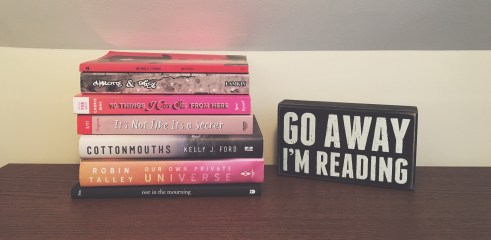
 “I think that, maybe, you get too close to things that are ugly because you want to make them beautiful. I see that you are suffering. But you have a gift. I don’t think you realize how special you are.”
  A man called Dunce who is bald with a pointed head, a couple who wishes that their genitals would fall off, and a clone who gets locked up in a shed, are all different types of people who make appearances in Nothing is Strange. The 20 short stories exist in their own fantastical lands that each have their own special laws of physics. What happens when right arms are nonexistent or the act of crying is never heard of? These things are just normal occurrences in Mike Russell’s writings.
 Charlotte has lived her life crippled by severe depression for too long. After multiple hospitalizations, she decides to apply for a procedure that would alter the way her mind functions. To Charlotte’s surprise, the doctors choose her to be their patient, the operation is done, and her brain is reconstructed. Suddenly, Charlotte’s life is turned around and she becomes interested in things that never appealed to her before, such as relationships and a career path. The only thing that could hinder her development is a malfunction in her programming, but her new life is worth the risk.
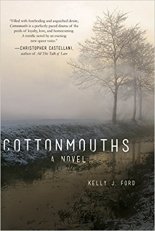 Emily Skinner, newly dropped out of college, is now back in her hometown in Arkansas. She’s living in her parents’ house, surrounded by gossip and judgment from her mom. To top it all off, Emily’s old crush, Jody, is back in town with her baby. Although Emily knows she’s trouble, she can’t stay away from Jody. After getting kicked out of her parents’ house over a dispute about her sexuality, Jody offers Emily a job as a babysitter and invites her to stay in her spare bedroom. Emily has always dreamed that maybe someday Jody could love her, especially considering the hints she’s giving lately. Soon, Emily realizes the mess that she’s walked into and, more important, realizes that she can’t escape it.
 Lovelace is learning to navigate to her body kit, something that she doesn’t consider part of her ‘self”, since she is really a program running inside of it. She is getting used to her new home with Pepper and Blue and they are getting used to having her, as they’ve had to make many changes to keep her comfortable. Lovelace doesn’t understand why Pepper is so adamant that she can survive in a kit; She feels like it’s not possible due to the way she was programmed specifically for a ship. She has no idea how Pepper grew up and what AI’s were in her life from a young age. Slowly, Lovelace learns to function in her new world and Pepper opens up about her dark upbringing.
 3/5 stars
 Hedgehog Book Reviews