Review- Understanding the Alacran

Understanding the Alacran by Jonathan LaPoma

Genre: Fiction
Binding: Paperback
Page Count: 422
Publisher: Almendro Arts
Publication Date: August 23, 2017

3/5 stars

UnderstandAlacran_FrntCvr_3.13.17“I think that, maybe, you get too close to things that are ugly because you want to make them beautiful. I see that you are suffering. But you have a gift. I don’t think you realize how special you are.” 

After seeing the darker side of teaching in the US, Will moves to Mexico to escape what could turn into a drug problem. Though he has a limited amount of savings that quickly dwindles, he manages to have some good times there. Most of Will’s days are filled with excessive drinking, partying, flirting with girls, and more drinking. He sees a pattern with the girls he gets involved with—they all leave him after a few days of fun. In a time of darkness, Will meets a woman who changes the way he views himself and the world.

-I was sent a copy of this book in exchange for an honest review-

The first thing that I want to mention is that I really, really disliked the main character, Will. This is not completely a bad thing, because it means Jonathan LaPoma wrote him as a very developed and multifaceted character. In the first few chapters, Will is meh, for me. He is just a young man trying to run away from a dark lifestyle that almost consumed him. As the story goes, his true colors of misogyny come out. He continuously treats women badly, hooks up with them, and then thinks horrible things about them once they dump him. He’s in this thought pattern of “woe is me, women are monsters and won’t give me a chance”, even though he has many preconceptions of different women before he meets them. I mean, this guy is super unlikeable. As I said, this means that he was written well and is a dimensional character.

I think the most important part about Understanding the Alacran is that it illustrates the ugliness of alcoholism. Will is obviously an alcoholic. He binge drinks almost every single night. There is a scene when he’s traveling with a woman who really wants him to stop drinking for a little while because they’re riding a bus with strangers. Will basically laughs at her and drinks excessively the whole trip. In addition, he also spends all his traveling money on beer and forces his angry companion to pay for his bus ticket. Blowing all of one’s money on alcohol and not caring how it affects other people is a sign of a drinking problem. There are also multiple times when he tells himself that he will not drink as much on certain nights. Without fail, Will always breaks his promises and gets blackout drunk. Not keeping promises that one sets for oneself is another sign of alcoholism. Describing traits of a drinking problem without trivializing it is important for education. I’m glad Jonathan LaPoma wrote about alcoholism in a responsible way and put this work out there for the public to learn from.

One thing that I didn’t like about Understanding the Alacran was the pace of the story. I remember at page 255, I was still wondering when I would get to the point of the book. Most of the book was just describing a man’s life without a big picture or purpose. The first 53% (I remember checking the percentage on GoodReads) really dragged on and I considered putting the work down completely. I’m really glad I didn’t, but the temptation was there. I wish the book had been 2/3 the length and left out some of the superfluous details of drunk nights and parties.

I have mostly good things to say about Understanding the Alacran, but the slow first half of the book bumped my rating down to a 3/5 stars. This book comes out in August, so be on the lookout for it! I recommend it to people who want to read about the reality of alcoholism. I want to thank Jonathan LaPoma for sending a copy of his work in exchange for an honest review.

Review- Nothing is Strange

Nothing is Strange by Mike Russell

4/5 stars

Genre: Science Fiction
Binding: Paperback
Page Count: 144
Publisher: CreateSpace
Publication date: December 31, 2015

25099252A man called Dunce who is bald with a pointed head, a couple who wishes that their genitals would fall off, and a clone who gets locked up in a shed, are all different types of people who make appearances in Nothing is Strange. The 20 short stories exist in their own fantastical lands that each have their own special laws of physics. What happens when right arms are nonexistent or the act of crying is never heard of? These things are just normal occurrences in Mike Russell’s writings.

Earlier this year, I was gifted a copy of Mike Russell’s other book, Strange Medicine. It was the first short collection in a long time that I actually enjoyed. I went into Nothing is Strange with high expectations and I was not disappointed. Thank you to the Strange Books team forsending me this title!

Mike Russell has a brain similar to Douglas Adams’. His stories make almost no sense at all, which actually makes them sort of make sense. He begins each short story in a world with at least one strange concept and then builds off of that with seemingly random events and characters. Reading his work is almost like riding a roller coaster, except you can’t see and don’t know where all the curves and drops are. Although, I don’t like roller coasters, but I liked Nothing is Strange.

My favorite thing about these short stories is that most of them don’t make any sense until the last paragraph or last sentence. Or in some cases, the stories don’t make any sense and the last sentence makes even less sense. For example, “Lesley Visits the Barber” ends with “thus beginning the universe”. While reading the story, I had no idea where I would end up, but the beginning of the universe was not it. I haven’t read a book that blindsided me so many times since finishing the “Dirk Gently” series a few years ago. That’s truly saying something about Mike Russell’s writing technique.

I also want to comment on the story length, as I think it says a lot. The stories range from 3 to 9 pages. That is not very much room to develop a made-up world and characters. The fact that Mike Russell can give enough detail and context for a reader to imagine the setting of each story is amazing. While reading Nothing is Strange, I never felt confused due to the short length of the book.

It’s clear to me that it takes quite a bit of talent to successfully write a collection of short stories such as Nothing is Strange. I’m so honored that Strange Books sent me a copy of this title in exchange for an honest review. It was such an enjoyable read for me, as I love science fiction. If you’re a fan of Douglas Adams, you’ll love this book.

Review- Charlotte and Daisy

Charlotte and Daisy by Amanda Rotach Lamkin

4/5 stars

Binding: Paperback
Publisher: Line by Lion Publications
Publication date: August 19th, 2015
Page count: 448

51YFXSPYupL._SX326_BO1,204,203,200_Charlotte has lived her life crippled by severe depression for too long. After multiple hospitalizations, she decides to apply for a procedure that would alter the way her mind functions. To Charlotte’s surprise, the doctors choose her to be their patient, the operation is done, and her brain is reconstructed. Suddenly, Charlotte’s life is turned around and she becomes interested in things that never appealed to her before, such as relationships and a career path. The only thing that could hinder her development is a malfunction in her programming, but her new life is worth the risk.
Amanda Rotach Lamkin does an amazing job depicting the realities of depression and how scary the illness can be. Charlotte has spent long periods of time in treatment centers, experienced bouts of the inability to get out of bed, and been prescribed many, many medications. These are all things that happen to real people who suffer from depression. It’s refreshing to read a book that doesn’t tip toe around the ‘unattractive’ symptoms of mental illnesses. It was also nice to see that, even after Charlotte gets her operation done, she is not 100% ‘cured’ of her illnesses. She still has times when her brain reverts back to things like catastrophic or black and white thinking patterns. Even with the brain surgery done, Charlotte still has to manage stress and triggers. Mental illnesses are always a work in progress, you cannot just ‘get better’ and be relieved of all symptoms forever, even in Charlotte’s case.

I really liked Charlotte’s boyfriend, Aidian, as well. He is the perfect example of how a loved one of someone with depression should act. Aidian is always there for Charlotte, good day or bad, and loves her unconditionally. I think that Amanda Rotach Lamkin did an excellent job writing the scene in which Charlotte has flashbacks while her and Aidian are being intimate. Flashbacks are a very real experience for people with PTSD and sex can be triggering. The way Aidian reacts to Charlotte’s flashbacks is very raw and it is easy to tell that he deeply cares about her, even though he doesn’t completely understand what is happening. Aidian truly is a good guy and the way he was written was perfect.

Actually, I want to dedicate a paragraph to a discussion about the flashback scene. Charlotte closes her eyes, experiences a flashback of being forced into sex when she was younger, and then runs away from Aidian and locks herself in the bathroom. Charlotte’s whirlwind of emotions of fear, confusion, and shame are all too real for people that suffer from PTSD and trauma related illnesses. Her body reacts in a way that she doesn’t understand and she feels ashamed of it. She is so ashamed that she doesn’t even want to explain what happened to Aidian, basically leaving him in the dark and unsure of what the problem was. This scene really proved to me that Amdan Rotach Lamkin is a responsible author who does her research on the characters she writes about.

Charlotte and Daisy was an excellent start to my BookCon haul. I wanted to read a new book about characters with mental illnesses for a while, so I’m really happy right now. I admire the work that Amanda Rotach Lamkin puts into her writing and character development; she wrote about depression and PTSD in a very responsible and educational way. In addition, this book is such a great homage to Flowers for Algernon. If you’re looking for a good diverse book, this is it.

Review- Cottonmouths (And Update!)

Hi everyone! I’m sorry for being a bit distant over the past week or so. I went on vacation for a week (apartment hunting!) and then attended BOOKCON! Last weekend was one of the best times of my entire life. I spoke with a lot of authors and publishers, some indie and some not, and connected with so many wonderful people. Everyone I talked to was very kind and we bonded over our shared love of diverse books. I can’t wait to read and review all the books I got from the convention! Stay tuned!

Now, for the review.

Cottonmouths: A Novel by Kelly J. Ford

 2.5/5 stars

Binding: Hardcover
Publisher: Skyhorse Publishing
Publication date: June 6th, 2017
Page count: 286

51TkKyf-iOL._SX332_BO1,204,203,200_Emily Skinner, newly dropped out of college, is now back in her hometown in Arkansas. She’s living in her parents’ house, surrounded by gossip and judgment from her mom. To top it all off, Emily’s old crush, Jody, is back in town with her baby. Although Emily knows she’s trouble, she can’t stay away from Jody. After getting kicked out of her parents’ house over a dispute about her sexuality, Jody offers Emily a job as a babysitter and invites her to stay in her spare bedroom. Emily has always dreamed that maybe someday Jody could love her, especially considering the hints she’s giving lately. Soon, Emily realizes the mess that she’s walked into and, more important, realizes that she can’t escape it.
I’m always on the lookout for upcoming lesbian fiction. I constantly watch and track new releases on Goodreads and BookRiot. I hadn’t picked up a lesbian mystery in a while, so my gut told me to start Cottonmouths. It isn’t my favorite book of June, but it is certainly interesting. If you’re not into F/F storylines, do not fear, because this book doesn’t really revolve around Jody’s sexuality, it’s more of a side topic.

I’m trying to pinpoint why this book wasn’t a 5 star rating for me. It has a lot of components that I usually love, like queer themes, so I’m a bit confused. I’ve done a lot of thinking and realized that Cottonmouths made me really, really uncomfortable. I’m generally not good with books that make me feel unnerved, creeped out, or otherwise squirmy. Some books are just too much for me– too scary, too gory, too cringeworthy, you name it. I’m not sure what this book was too much of, but something left me feeling unsettled. I’m not someone who enjoys uncomfortable books, but this book is perfect for someone who is able and likes to stomach them.

Something that I did like about Cottonmouths was how much it reminded me of Gillian Flynn’s writing style. It’s most comparable to Sharp Objects, in my opinion. There is less blood, but it has the same concept of a protagonist who the reader slowly beings to like less and less as the book goes on. In the beginning, Jody is someone who you can really feel sorry for, since she just dropped out of college and is struggling to find a job. As the chapters go by, Jody becomes less relatable and more unlikeable. This is something that makes me admire an author, because it’s not easy to do well. I think Emily J. Ford did a nice job transitioning Emily from a sweet girl into a dangerous woman in love with the wrong person.

Another great thing about Cottonmouths is the character depth. Emily and Jody both have so much going on inside them. Neither of them is all good or all bad, which can make it difficult for the reader to determine who is the one they should be “rooting for”. Kelly J. Ford does an excellent job making some things obvious (Emily is in love with Jody) but keeping a few key things secret (but, does Jody love Emily back?). I really have a hard time with books with no redeemable characters, so this was a downside for me, but I’m sure it’s an upside for some people.

I really wish I had been able to stomach Cottonmouths a bit more. The characters were very well developed and Kelly J. Ford excelled at making all her major characters very dislikable. Unfortunately, it wasn’t the right pick for me, for personal preference. I’d recommend this to someone who wants a good mystery that leaves them feeling uncomfortable and angry with the main characters.

Review- A Closed and Common Orbit

A Closed and Common Orbit by Becky Chambers

4.5/5 stars

Binding: Hardcover
Publisher: Hodder & Stoughton
Publication Date: October 20th, 2016
Page count: 365

29475447Lovelace is learning to navigate to her body kit, something that she doesn’t consider part of her ‘self”, since she is really a program running inside of it. She is getting used to her new home with Pepper and Blue and they are getting used to having her, as they’ve had to make many changes to keep her comfortable. Lovelace doesn’t understand why Pepper is so adamant that she can survive in a kit; She feels like it’s not possible due to the way she was programmed specifically for a ship. She has no idea how Pepper grew up and what AI’s were in her life from a young age. Slowly, Lovelace learns to function in her new world and Pepper opens up about her dark upbringing.

I’ve loved Becky Chambers since I got through the first 10 pages of The Long Way to a Small, Angry Planet last year. The way she creates and describes alien cultures is so real. Honestly, it makes you feel like these species have been around your whole life, not that you’re just learning about them now.

In her last book, I loved the way Becky Chambers played around with gender. Some of the alien creatures she describes change genders throughout different periods of their lives. This also means that their pronouns change many times in the book. A Closed and Common Orbit was no different. Tak, one of Lovelace’s friends, changes from female to male. No one questions it or struggles with the pronoun change. Tak just is Tak and everyone adjusts to the way their identity changes. I think Chambers does an amazing job showing that gender is a social construct and, also, that it is completely different from sex. In addition, everyone is assigned gender-neutral pronouns until they indicate their gender or pronoun preferences. This kind of trans-inclusive language is key for transgender folx to feel safe and respected, and it really makes the reader think about the preconceptions we hold about people before getting to know them in our own society.

Becky Chambers completely has the sci-fi formula down pat. She includes everything you need in a well written, page turning, science fiction novel. Some of these ingredients include a system of unique planets that house different species, space travel, artificial intelligence, alien cultures, and alien relationships. I have yet to come across another author who completes their sci-fi formula so efficiently. I swear, I could give A Closed and Common Orbit to anyone, even those who don’t enjoy classic science fiction novels, and they’d enjoy it. She really knows what she’s doing.

Lastly, I want to point out the way Lovelace is treated– as a character. Yes, she’s a spaceship program loaded into a body kit. Yes, she’s not considered a full human in her world and is technically committing a crime by merely existing. Despite all this, Chambers treats her like a ‘real’ person and gives her the same existence as everyone else in the book. I know AI’s aren’t really part of diverse reading, but it was comparable, in my mind. Giving someone, who society considers a less-than, the same opportunities in a story as the rest of the characters is what queer characters, characters of color, and characters suffering from chronic illnesses want to see in literature. I know it’s not the same, but I felt really good reading A Closed and Common Orbit for this reason (and many others outlined in this review!).

Just as I expected, I absolutely loved this book. It’s definitely different from her first book, considering most of the plot takes place on a planet and not space, but that’s not a bad thing in the slightest. I will continue to support Becky Chambers throughout all of her works, as I recognize the importance of the way she treats gender, in addition to the extraordinary way she describes alien species and their behaviors. If you’re looking for an outstanding science fiction novel, this is it.

Review- I Must Have You

I Must Have You by JoAnna Novak

33253060._UY400_SS400_3/5 stars

Elliot is 13 years old and has suffered from anorexia for a long time. The illness has consumed her so much that she is now a diet coach for other girls at her school. Of course, her dieting techniques are all based on eating disorder thought processes and the girls are getting trained in unhealthy behaviors. Elliot’s best friend, Lisa, who she has very deep feelings for, recently got out of an inpatient hospital program for eating disorders and wants nothing to do with her anymore. On top of that, Elliot’s mom suffers from bulimia, herself. Elliot wants Lisa back, she wants her mom to be happy, and she wants ‘her girls’ to succeed in weight loss.

Eating disorders are not written about very often in literature and, when they are, it’s usually in young adult books. I Must Have You is definitely an adult book, with very adult content, so I was really excited to pick up this book. The way eating disorders were presented was great, so I’m going to start my review with that.

Elliot very clearly has extremely distorted thoughts involving food and body image. She spends her lunch making copies of her dieting magazine, which she hands out as motivation to her ‘clients’. JoAnna Novak’s way of portraying Elliot’s illness is so detailed that she includes a scene where Elliot is looking at photos of emaciated people in the library stacks for inspiration. JoAnna Novak also consistently includes descriptions of the tiny exercises that Elliot performs while doing every day activities, like working her calves as the microwave warms her low calorie meal. Almost everything Elliot says has something to do with food, exercising, dieting tips, or her friend Lisa.

Lisa, on the other hand, is trying so hard to get Elliot’s ‘tips’ out of her brain. She has just gotten out of inpatient hospitalization and is constantly battling with eating disorder behaviors in her brain. Many times, she identifies when she is thinking in an unhealthy thought pattern and switches her brain into recovery mode. Novak did an amazing job researching what happens to adolescents after they are discharged from programs like that. It is common for individuals to be set up with therapists who do exactly that, teach them how to change their unhealthy thoughts into healthy ones.

The way eating disorders were written about in I Must Have You was brilliant, but the writing was lacking. In the first few pages of the book, I had to go back and read passages multiple times because I couldn’t figure out who was who. The book was introducing so many new characters in the same 4 paragraphs and it was really confusing. I actually had to look at some reviews on GoodReads, which explained all the friendships and families, to get all the characters straight. Unfortunately, the writing still continued to jump around all over the place as the book went on. I found myself confused by the erratic sentences more times than I would have liked.

Lastly, I wish the ending wrapped up with a major takeaway. Conclusions are so important in literature, especially when a book is about a stigmatized topic, like mental illness. JoAnna Novak could have blown her readers away with the final pages showing that eating disorders are illnesses that need to be properly treated and recognized as such. Imagine, a book that features 3 main characters with eating disorders, and it wraps up with a message about the severity and validity of their illnesses. I’m not quite sure what my dream ending for this book is, but I know I’m not satisfied with what I read.

I Must Have You was just okay. I usually don’t write full reviews for books that I didn’t really like, but I’m making an exception because the themes of this book are so important. I’m really impressed with the research JoAnna Novak put into the minds and habits of her characters, but I’m disappointed with her writing style and conclusion. I hope to soon see adult books that feature protagonists with mental illnesses, such as eating disorders, make their way to the bestseller list.

Review- One Year Left

One Year Left by J.C. Robinson

34743713._UY1000_SS1000_Rating: 3/5 stars

Will has one year left to live. His last wish is to move to a new city, Portland, and spend his time working on a food truck with his close friend. Will doesn’t put much research into his new house, neighborhood, or, most importantly, roommate. She introduces herself as Kristen and captures his attention from the moment he meets her. At the time, Kristen is in a failing relationship with a guy who doesn’t listen to her and heavily buys into the gender stereotype of women being the people who cook dinner. Will knows that he cannot pursue Kristen when she’s taken, but the possibility of her becoming single appears, and he might have a shot at making things work after all.

I want to thank the author of One Year Left, J.C. Robinson, for giving me a copy of this book in exchange for an honest review. I’m honored that you chose me to read your work!

I have a lot of mixed thoughts on this book. I want to start by saying that the story kept me glued to the pages. The plot was very smooth and the conversations flowed easily. There wasn’t too much dialogue or too little plot development. J.C. Robinson did an excellent job balancing all the dynamics of the book and making it easy to follow and fun to read. In addition, there was a clear beginning, climax, and resolution track. A lot of romances don’t have an actual plot, so that was refreshing to read.

I am not very fond of the way Will and Kristen were written. They feel very shallow to me, almost like they rely on a lot of tropes from romance movies. Will is the good, semi-awkward guy who never got the girls in high school and Kristen is the girl who always ends up with the wrong guys who treat her badly. This makes them absolutely perfect for each other, but also creates a boring and predictable storyline. I understand that romances are supposed to be predictable, because the main character and their love interest usually end up together, but this was too stereotypical for me.

In addition, I wish the ending wrapped up more plot and showed the reader how it affected the ‘big picture’. I felt pretty empty handed during the last few pages of One Year Left and wanted to see more final character development within Will. He doesn’t evolve much from the person he is in the first chapter of the book. I love getting a sense of clarity about the takeaways of a book when I finish it, and I didn’t get that from this. I am sad because Will and Kristen were written with such great chemistry and I was rooting for them! I wish the last 10 pages had as much thought put into them as the rest of the book.

Overall, I both liked and disliked a lot of things about One Year Left. The way the book read, as a whole, was perfect. I couldn’t put it down and wanted to get to the ending as quickly as possible. On the other hand, Will and Kirsten were not very dimensional; you can see other characters just like them in many popular romantic comedies. Unfortunately, this led to little character development and a sub-par conclusion that left me wanting more. This book is a very quick read, because of its length and fast-paced plot, so I’d recommend it to someone looking for an easy romance. It’s very feel-good, so it’s a great read to put you in a good mood. Again, a big thank you to J.C. Robinson for giving me a copy of his work. I really enjoyed reviewing it!

Review- The Inexplicable Logic of My Life

23447923The Inexplicable Logic of My Life by Benjamin Alire Saenz

4/5 stars

Sal has a very comfortable life with his adoptive gay father and their dog; just the three of them, no drama and no changes. During Sal’s senior year of high school, he begins to experiences changes within his body that he cannot quite name. He starts acting out by throwing punches at guys who call him and his father slurs. He also finds himself wondering about his biological father and which genes could have been passed down from that mystery man. Sal has always been the one with his emotions under control, especially compared to his best friend, Sam, who seems to be all over the place feeling-wise. Suddenly, Sal is not quite sure what’s going on with himself and he questions his place in life and family.

This book is so cute. I’m going to reiterate something that I read in a few Goodread’s reviews and mention that it doesn’t really have a plot. Although there’s not a climax or much of a resolution, it’s still a great story with lovable characters and beautiful family dynamics.

Family and relationship dynamics seem to be Bejamin Alire Saenz’s specialty. His best selling book, Aristotle and Dante Discover the Secrets of the Universe, is full of families and budding relationships that make your heart happy. He’s a pro at showing readers the different ways a curious son and a father, two different gender best friends, and a distant mother and daughter can love each other. The Inexplicable Logic of my Life really emphasizes that love can be shown in different, unconventional ways that the recipient may not be able to see. Everybody needs someone to point out the ways they’re being loved at some point in their life. I’m glad that Sal was able to narrate that to me in his own, 17-year-old voice. It was really refreshing to hear it from someone learning to recognize the ways his friends and family showed their feelings, even if they were hidden.

I really like the way Saenz incorporated gay characters into this book. Sal and Sammy, the two most prominent characters, are both heterosexual and actively talk about liking the opposite sex. Sal’s father is gay, but that is not his primary identifier. Sal thinks of him as his dad, not a gay man. This is an important way to write about LGBT secondary characters because it normalizes queerness. It is a great way for LGBT readers to see themselves in literature and a great way for them to be REPRESENTED. Queer people want to see themselves in books, even when a gay relationship is not the center of the storyline. This is mostly because LGBT people exist everywhere, everyday, so of course it would be normal to have them in every book. Everyone, take notes from Saenz: Just because a book does not center around a queer relationship doesn’t mean it shouldn’t have queer characters.

I also want to comment on Sal, as a character. He was extremely likable and multidimensional, which is often not well executed. I’ve read a lot of books where the characters were filled with crowd-pleaser personality traits but had zero depth. This was not one of those books. Sal had many, many things that I admired about him but he also had a lot of thought go into his emotional complexion. In the first few pages, I thought Sal would fit into the typical “good boy” trope, but soon learned that he has a lot more to him and his thought patterns. Getting to know him was an honor.

The only negative critique I have about The Inexplicable Logic of My Life is the lack of plot. I do wish there had been a climax and true resolution at the end. I had to motivate myself to pick up the book a few times and an ongoing plot line would have helped me push through it. Other than that, this book was the perfect feel-good read. I’m glad that I got to meet Sal and I hope to read more of Saenz’s work in the near future.

Review- Go Ask Alice

Go Ask Alice by Beatrice Sparks (Anonymous)

5/5 stars

41hYMaMVw+LThe Anonymous “Alice” is a 15 year old girl who gets caught up in the world of drugs after unknowingly trying a drink laced with LSD at a party. After that one drink, she can’t stop thinking about that initial high and seeks out other drugs. This quickly spirals into tranquilizers, sleeping pills, weed, and heroin. Alice runs away multiple times, sometimes living with friends and other times living on the street. She never really finds the proper treatment, despite her parents trying their best. Ultimately, even though Alice seems to be doing well at the end of the diary, drugs take her life in an overdose.
I’m surprised at all of the negative reviews of Go Ask Alice on Goodreads. I know this book is a bit cheesy and unbelievable, since almost every cliche in the drug world happens to Alice, but it really is an important read. This book is so educational for parents and teens. Although a bit unrealistic, it shows the dangers of experimenting with even just one drug and how that easily can lead to more substances.

Go Ask Alice is a wake-up call to loved ones of children, teens and adults alike. Understanding the signs of drug abuse, social withdrawal, acting out, changing of friends, and lying, is SO critical. The red flags before addiction takes someone’s life is important for loved ones to insure someone’s safety. In addition, making sure someone has the proper treatment after dealing with substance abuse is just as crucial. As a society, we need to stop teaching people that addiction is the addict’s fault and that they choose that road for themselves. Recovery programs tell patients that addiction is a disease and treatable with proper medication and therapy. I would argue that education for family members and loved ones of addicts is just as important as the actual treatment for the individual. Please, stop spreading self-blaming messages that tell addicts that their addiction is their fault.

Character and plot wise, Go Ask Alice is nothing special. It is told in diary format that’s very easy to read, at the level of a middle schooler. This makes it suitable for a variety of ages. The plot progresses very quickly, as the diary sometimes jumps ahead weeks at at time between entries. Alice is not very good at writing consistently, so there are many plot holes. Besides Alice, most of the characters are pretty undeveloped. I suppose that is the nature of a diary.

Naturally, the big question is if the book is fiction or not. To me, that doesn’t matter so much. In my opinion, the book was “written” to educate people on the reality of addiction and the importance of proper treatment. Alice may not have really existed, but she very well could have. Addiction discriminates against no one, so who is to say that “Alice” could not really exist somewhere?

I gave this book 5 stars not for the writing but for the take-aways. This is a crucial book for our society to read. I wish this had been a community read at my high school when I attended because it would have spread awareness about addiction around my community and started conversations about treatment and care. Please, please, read this book.

Review: Ascension

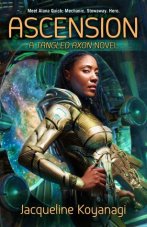
Ascension by Jacqueline Koyanagi

177512745/5 stars 

“Pain is just the world wanting us to pay attention to it because we’re so damned beautiful it can’t stand being ignored.”

Alana Quick is stuck; she repairs spaceship engines for a living and doesn’t make enough to pay for the advanced medication she needs for her chronic pain. Her and her aunt Lai both suffer from a disease, Mel’s, that puts their bodies under enormous stress and pain when they don’t take medication. Alana dreams of being able to afford treatments for her and Lai someday, and the only thing she needs is a steady job. The opportunity finally arises when Alana gets a visit from a spaceship captain in search of her sister. Alana makes the gut decision to stow away on the ship in hopes that, once they are far enough away, the crew will be forced to keep her on board for the remainder of their current mission. This is Alana’s only chance at making a better life for her and her aunt, maybe the crew of this ship can understand that and take her onboard as an engineer.

WOW. This book has a mix of everything I’ve ever wanted. It has a space ship, a crew of multi-alien-cultures, a main character of color with a disability, and many queer characters whose plot lines don’t revolve around being queer. If this sounds like something you’d love, like it does for me, read on!

Sidenote: This book is VERY comparable to A Long Way to a Small, Angry Planet. I loved both books and would recommend them to basically anyone who likes science fiction.

Ascension is full of diversity. One of my favorite parts about science fiction is getting to read about new, unique alien cultures and species, and Jacqueline Koyanagi really incorporated that into this book. Really, all of the characters ware anthropomorphic (mostly,,,), but all of them are from different cultures and go through life with unique things in mind. The author really does an amazing job portraying that they all have their own sets of values and beliefs about how the world works. Often, it’s hard to give each character their own personhood, especially when there are many individuals in a regular length novel, but Jacqueline does it very well.

This is the first adult book I’ve read that really puts chronic illness and pain in the spotlight. It’s a very easy thing to get wrong, by trivializing it or romanticizing it, but when it’s done right, it is done RIGHT. Alana is an independent woman with a strong work ethic and heart full of determination. In addition, she also suffers from a chronic illness. This disease, Mel’s, acts up unexpectedly. Alana has some good days and some not so good days, just like a real person with chronic pain. When Alana has flare-ups, she takes her medication as prescribed and works through it. Seeing her push through the horrible pain and tremors is heartbreaking because real people suffering with real invisible illnesses experience this all the time. I think it’s very important to normalize books that have main characters with disabilities because actual people like that are EVERYWHERE.

I also want to mention the representation of people of color in Ascension. Many books introduce characters by giving a physical description—hair color, skin tone, and clothing style. Ascension does this by mentioning that Alana pulls her “locs” back out of her face and the dark complexion of her skin. The thing that this book does that most others don’t is that it doesn’t let the reader forget that Alana is a person of color. Her locs, the texture of her hair, and the color of her skin are all mentioned multiple times. Jacqueline did not write Alana and just add on the fact that she’s a person of color, she wrote Alana AS a person of color. This is so important for representation.

Everything about this book was an A+ for me– The characters, the storylines, the writing, and the takeaways. It’s everything you could ever want from a sci fi book. This book made me happy in so many ways but there are two I want to highlight: Ascension does an amazing job portraying what it’s like to live with a chronic illness and it successfully uses minorities (sexuality and race wise) as more than just plot devices. Thank you, Jacqueline Koyanagi, for this brilliant book.